
Data Security in a Correctional EHR – Protecting Health Information in High-Risk Environments
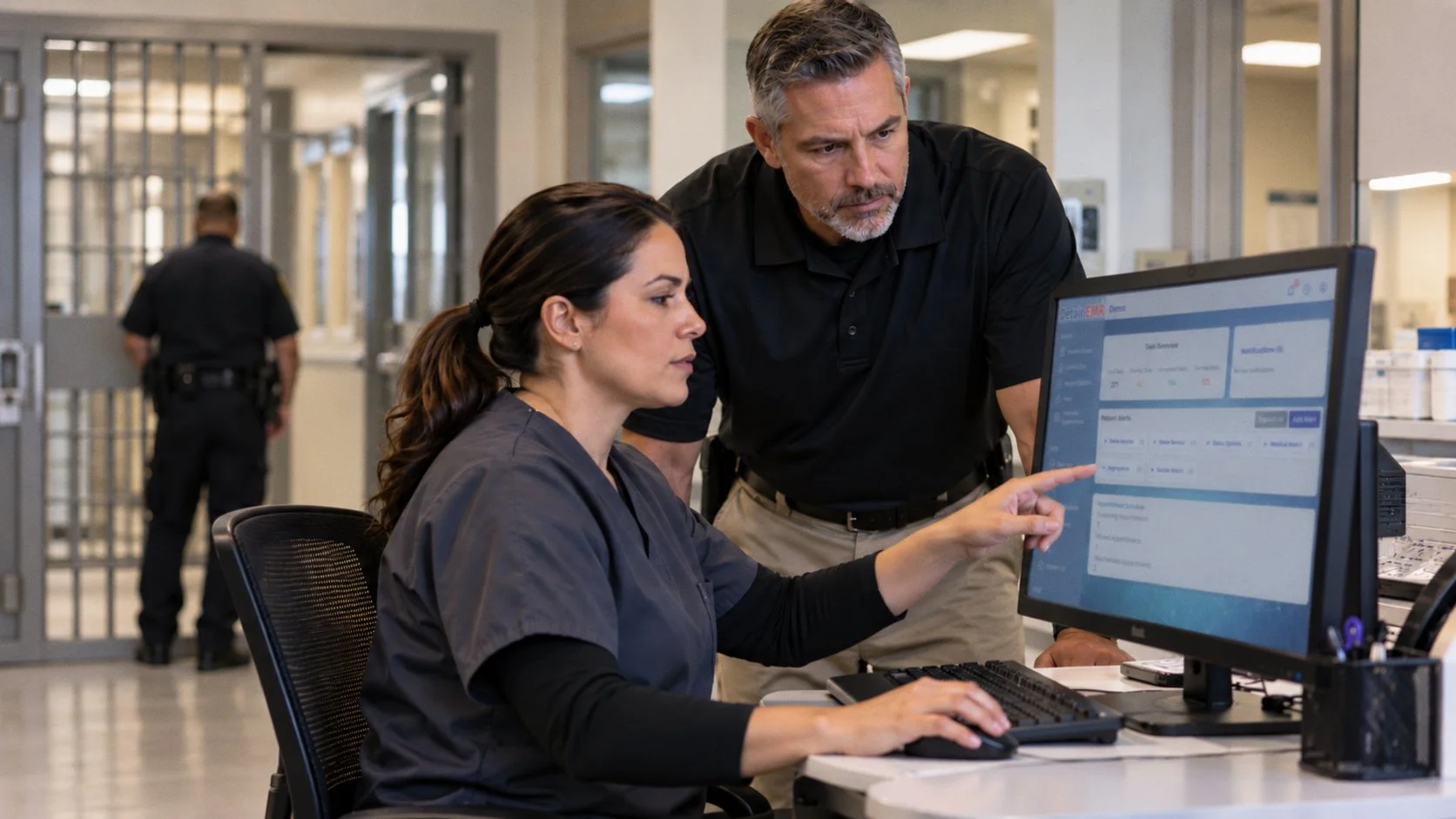
Patient health records contain sensitive information that calls for careful protection in a correctional setting. As correctional administrators evaluate which electronic health record (EHR) system is the best choice for their facility, they should look beyond basic cybersecurity claims and understand how an EHR controls access to protected health information (PHI) while keeping it available for patient care.
Control Access by User Role
Not everyone working inside a correctional facility needs access to the same health information. A nurse may need a patient’s medical history, medications, and recent clinical documentation, while custody staff may need limited health information related to housing or transportation. Outside healthcare providers may also need records when a patient leaves the facility for treatment.
The National Commission on Correctional Health Care (NCCHC) states that confidentiality should be maintained for written and electronic health records and that the responsible health authority should control access to health information. A correctional EHR can support that approach through role-based permissions that limit what authorized users can see or update based on their responsibilities.
During a demonstration, ask vendors to show these controls using realistic facility roles. Compare what a nurse can access with what custody staff or an administrator can see, then ask how permissions are changed when an employee changes roles or leaves the facility.
Monitor Activity Within the EHR
Protecting health information involves ongoing control over what users can access and how the EHR tracks their activity. The HIPAA Security Rule addresses safeguards including access controls, audit controls, authentication, integrity protections, and transmission security for electronic PHI.
Audit capabilities create an activity record within the EHR, giving authorized administrators a way to review who accessed patient information and what actions occurred. This can be especially relevant in a correctional setting, where employees may access health information for different operational reasons.
Ask vendors to show how the system records and reviews activity. Seeing these capabilities in a realistic correctional workflow can clarify how the facility would investigate questions about access to a patient record.
Keep Information Available During Disruptions
The HIPAA Security Rule addresses both the protection and availability of electronic PHI. In a correctional setting, healthcare operations continue during technology disruptions, so facilities should know how patient information remains protected and accessible when normal EHR access is interrupted.
During an EHR demonstration, ask how the system supports healthcare operations during downtime and how information is protected when stored or exchanged. Because cybersecurity practices continue to evolve, HHS emphasizes ongoing risk analysis and security management. Facilities should also understand how a vendor evaluates its security practices as technology and cyber threats change.
Five Steps for Evaluating EHR Data Security
1. Demonstrate access by role. Ask the vendor to show what different users can see and update within realistic correctional workflows.
2. Review audit capabilities. See how the system records access to patient information and what authorized administrators can review when questions arise.
3. Ask how PHI is protected. Find out how health information is safeguarded while stored and when it moves between authorized systems or healthcare providers.
4. Examine access changes. Ask how permissions are modified or removed when an employee changes responsibilities or leaves the facility.
5. Review ongoing security practices. Find out how the vendor approaches security reviews, workforce training, risk assessment, and emerging cyber threats.
DetainEMR is more than just a standard EMR, it’s an award-winning electronic health record software designed specifically for correctional environments. If your facility is evaluating its current EHR or exploring new correctional healthcare software, contact the DetainEMR team to schedule a demo and see how a correctional EHR can support your operation. You can also visit our Features page to explore the EHR capabilities available within DetainEMR.